
It’s Tuesday, 11:40 p.m. You’re brushing your teeth when it hits you: did that gym membership renew? You open your banking app, scroll for a bit, see a charge you don’t recognize, decide it’s “probably fine,” and go to bed slightly less fine than you were five minutes ago.
Thursday, in the checkout line, you wonder if you can afford the thing in your hand. Saturday, a friend suggests dinner and you do some fuzzy math in your head. Sunday night, a vague dread about “money stuff” settles in, right on schedule.
Sound familiar? Here’s the thing: you’re not bad with money. You’re just thinking about it all the time, in tiny anxious slices, and never actually dealing with it.
Today’s habit fixes that, and it needs no budgeting app and no spreadsheet. Just one calm 20-minute check-in a week, with a coffee and a four-line checklist. I call it the Weekly Money Date.
Money Worry Doesn’t Keep Office Hours

Money worry is a terrible employee. It shows up uninvited, at the worst moments, does no actual work, and leaves you more tired than before. The 11 p.m. app check. The “wait, how much was that?” in the shower. The low hum of not quite knowing.
And every one of those half-checks costs something: a bit of attention, a bit of calm, a bit of sleep. None of them ends with a decision. You look, you wince, you close the app.
Worse, many of us do the opposite and avoid looking altogether. Economists even have a name for it: the ostrich effect. Researchers George Loewenstein, Niklas Karlsson and Duane Seppi found that investors checked their portfolios more often when markets were up and noticeably less when they were down. We peek when the news is likely good and hide when it might be bad. (Relatable? Deeply.)
Why One Slot Beats a Dozen Half-Checks
This isn’t just a nice idea. Psychologists have been testing “give the worry an appointment” for decades.

Back in 1983, a team led by Thomas Borkovec tried a simple trick with chronic worriers: set aside a 30-minute worry period at the same time and place each day, and when worry pops up outside it, postpone it to that slot. It reduced how much of the day people spent worrying. The worry didn’t vanish. It just got a parking spot.
There’s a second piece. Unfinished tasks tend to nag at us, but in a set of experiments, psychologists E.J. Masicampo and Roy Baumeister found that making a specific plan for an unfinished goal largely stopped those intrusive thoughts. Your brain doesn’t need the problem solved right now. It needs to know when it will be handled.
A Money Date is that “when.” One scheduled slot replaces a dozen anxious half-checks. When the 11 p.m. thought shows up, you can tell it: “Sunday. Coffee. We’ll look then.” And you actually will.
That’s the minimalist move here. Not a new system on top of your life, but one ritual that quietly replaces a whole week of mental clutter.
Your 20-Minute Money Date

Pick a time, pour a coffee, open your banking app (or two, if you have a couple of accounts), and work through four short steps. Set a 20-minute timer. When it rings, you’re done, even if it wasn’t perfect.
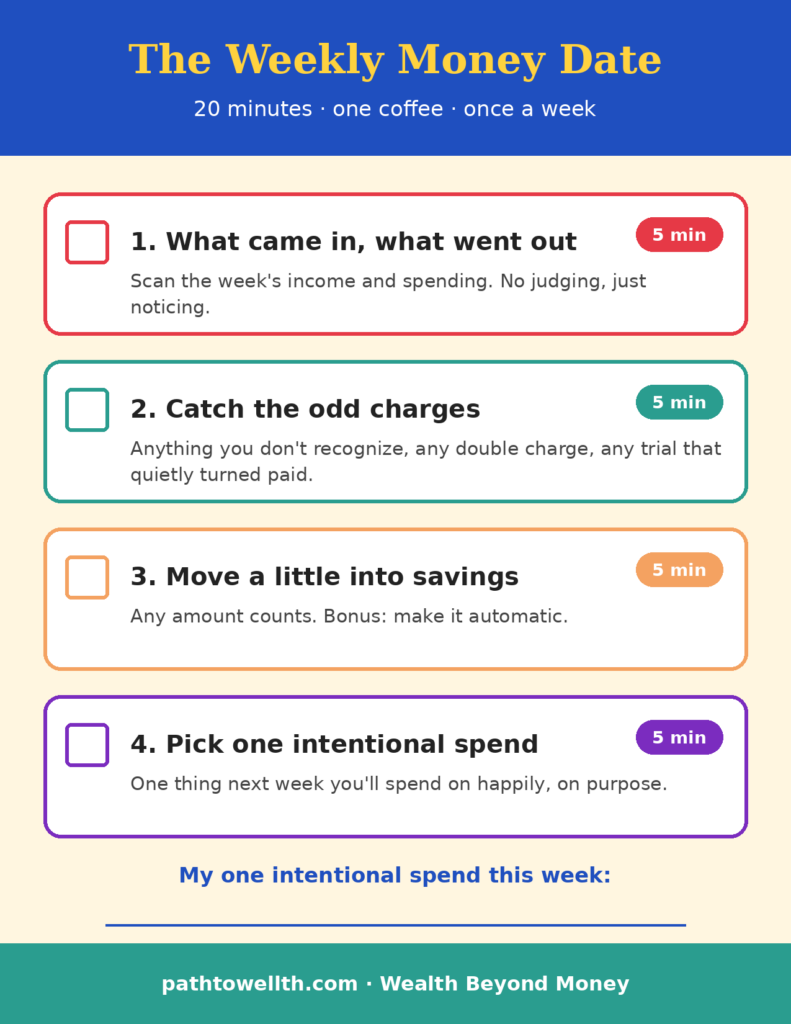
1. What came in, what went out (5 minutes)
Scroll through the last seven days. Paycheck, freelance payment, transfers in. Groceries, rent, the three coffees, the random online order. No judging, no categories, no color-coding. You’re just noticing. Most of the stress lives in the not-knowing, and five minutes of looking usually shrinks it.
2. Catch the odd charges (5 minutes)
Now look for anything weird:
- Unknown names: a merchant you don’t recognize. Look it up, and call your bank if it still makes no sense.
- Double charges: the same amount, the same store, twice.
- Quiet renewals: the “free” trial that turned paid, or the yearly plan you forgot about.
- Price creep: a subscription that costs a little more than last month.
If you’ve already done The Subscription Sweep, this is how you keep it swept. One big clean-out, then a weekly glance so nothing new sneaks back in.
3. Move a little into savings (5 minutes)
Move something into savings. $20, $10, $5. The amount matters far less than the habit of paying yourself on purpose, every week. Over time, the goal is to make this automatic (more on that in the challenge), so the Money Date becomes a check, not a chore.
4. Pick one intentional spend for next week (5 minutes)
This is my favorite part. Choose one thing you’ll spend money on next week, happily and on purpose. Dinner with a friend. A good bag of coffee beans. Tickets to something. Write it down.
It flips the whole ritual from “what did I do wrong” to “what do I want.” And when you’ve already chosen your treat, it’s much easier to shrug off the random ones.
Make It a Date, Not a Chore
The secret ingredient is the coffee. Seriously. Tie the Money Date to something you already enjoy, at a time you already have, and it stops feeling like homework.

For a lot of us, that’s the slow Sunday coffee. You’re already sitting down. The week is behind you, the next one hasn’t started. It’s the perfect little window.
- Same time, same place: Sunday 10 a.m., kitchen table, favorite mug. The cue does half the work.
- Make it nice: good coffee, a pastry, music on. You’re rewarding the habit while you do it.
- Keep it short: 20 minutes, then stop. A ritual you can keep beats a deep dive you dread.
- Invite your person: if you share money with a partner, make it a real date. Two coffees, one checklist, zero blame.
If Sunday is already your meal prep day, even better. Prep the food, then prep the week’s money. Same energy, same “future me will thank me” glow.
What This Has to Do With Wellth

Twenty minutes a week is about 17 hours a year. That’s less than one day a year, and unlike the half-checks, it actually gets things done.
Health. Fewer 11 p.m. money spirals means calmer evenings and a quieter mind at bedtime. That’s not a small thing.
Habits. One weekly ritual compounds. Each Money Date makes the next one shorter, because there’s less to catch. It’s the same idea as the Single-Tab Hour: one focused slot instead of constant, scattered attention.
Smart Money Moves. You catch the odd charges while they’re small, you save on autopilot, and you spend on purpose. If emotional spending is your weak spot, the weekly look pairs perfectly with the tools from our stress spending post: you’ll start to see the patterns, not just the receipts.
Your 30-Day Money Date Challenge
Ready, Wellthers? Four Money Dates in a row. Each week keeps the previous steps and adds one new one.
Week 1, Review: Pick your slot and do steps 1 and 2. Just look at what came in, what went out, and anything odd. That’s it.
Week 2, Cancel or adjust one thing: Review again, then act on one thing you found. Cancel a subscription, dispute a charge, or downgrade a plan. Just one.
Week 3, Automate one transfer: Set up a small automatic weekly or monthly transfer into savings, timed for right after payday. Now saving happens even on weeks you forget.
Week 4, Set one intentional spend: Run the full four-step date and pick next week’s intentional spend. Enjoy it. Fully. No guilt allowed.
Your Money Date Checklist
Save it, print it, or stick it on the fridge next to the coffee machine.
Twenty Minutes, Once a Week
You don’t need to become a finance nerd, download another app, or build the perfect spreadsheet. You need one ordinary slot, one coffee, and four questions.
Some weeks you’ll skip it. Some weeks it’ll take eight minutes because nothing happened. Both are fine. It’s not about perfection, it’s about showing up for your money on purpose, so it stops showing up uninvited the rest of the week. Your future self will thank you.
So this Sunday, pour the coffee, open the app, and ask yourself: what would my week feel like if money had one calm appointment instead of a dozen anxious drop-ins? ☕️