
It’s 11:15 p.m. The dishes are still in the sink. Tomorrow’s meeting is “sometime in the morning,” you think, though you haven’t actually checked. You’re in bed, which is progress, except your phone is in your hand, and a sale email just became a 20-minute scroll. You’ll deal with it tomorrow.
Sound familiar? We’ve all been there.
Here’s the thing: tomorrow morning is mostly decided tonight. The sink will still be there at 7 a.m. The calendar won’t have gotten clearer while you slept. And that scroll rarely ends with a great night’s sleep, or a purchase you’re proud of.
Today’s habit costs nothing, needs no app, and takes ten minutes. Put the kitchen and the main room back in order. Write tomorrow’s top three tasks and check the calendar. Then wind down: screens off, clothes out, coffee set. That’s it.
The Night Before Decides the Morning

We treat mornings as if they start from scratch. They don’t. They inherit whatever we left them: the mess, the unmade decisions, the vague sense that something is probably due.
A rushed morning isn’t usually a character flaw. It’s a leftover evening.
I used to think I needed a more heroic morning routine. A 5 a.m. alarm, a journal, a smoothie, a personality transplant. (Spoiler: I did not become that person.) What actually helped was much smaller, and it happened the night before. When the counters are clear and tomorrow already has a shape, you spend your first hour living, not scavenging. You don’t hunt for a shirt. You don’t discover a 9 a.m. call at 8:47. You just start.
The Hidden Cost of “I’ll Deal With It Tomorrow”
“I’ll deal with it tomorrow” feels like rest. It isn’t always. It’s often just a postponement, and postponements have interest.

In a UCLA study, psychologists Darby Saxbe and Rena Repetti looked at how people described their own homes. Women who talked about clutter and unfinished projects had a flatter daily pattern of the stress hormone cortisol, a pattern linked to chronic stress, and their mood tended to get worse as the day went on. The unfinished room keeps tapping you on the shoulder.
Unwritten tasks don’t politely wait until morning. They loop. A research team at Baylor University, led by Michael Scullin, had young adults spend five minutes at bedtime either writing a to-do list for the next few days or journaling about tasks they’d already finished. The people who wrote the to-do list fell asleep significantly faster, and the more specific the list, the faster they dropped off.
And then there’s the scroll. The CDC recommends turning off electronic devices at least 30 minutes before bed. In a 2023 survey from the American Academy of Sleep Medicine, 75% of U.S. adults said they’d stayed up past their intended bedtime to shop online. Late-night browsing is where “just checking” turns into a package you forgot you’d ordered. (Your future self, opening the box, will have questions.)
Every postponed dish, unwritten task, and extra scroll is a small tax on tomorrow. Pay it often enough, and mornings feel harder than they need to.
Your 10-Minute Evening Reset

The fix is almost suspiciously simple. Ten minutes. Three steps. No new system, no labeled storage bins, no weekend “big clean.” Just a short daily reset, so the mess never gets a chance to become a project. Set a timer if you want. When it rings, you’re done.
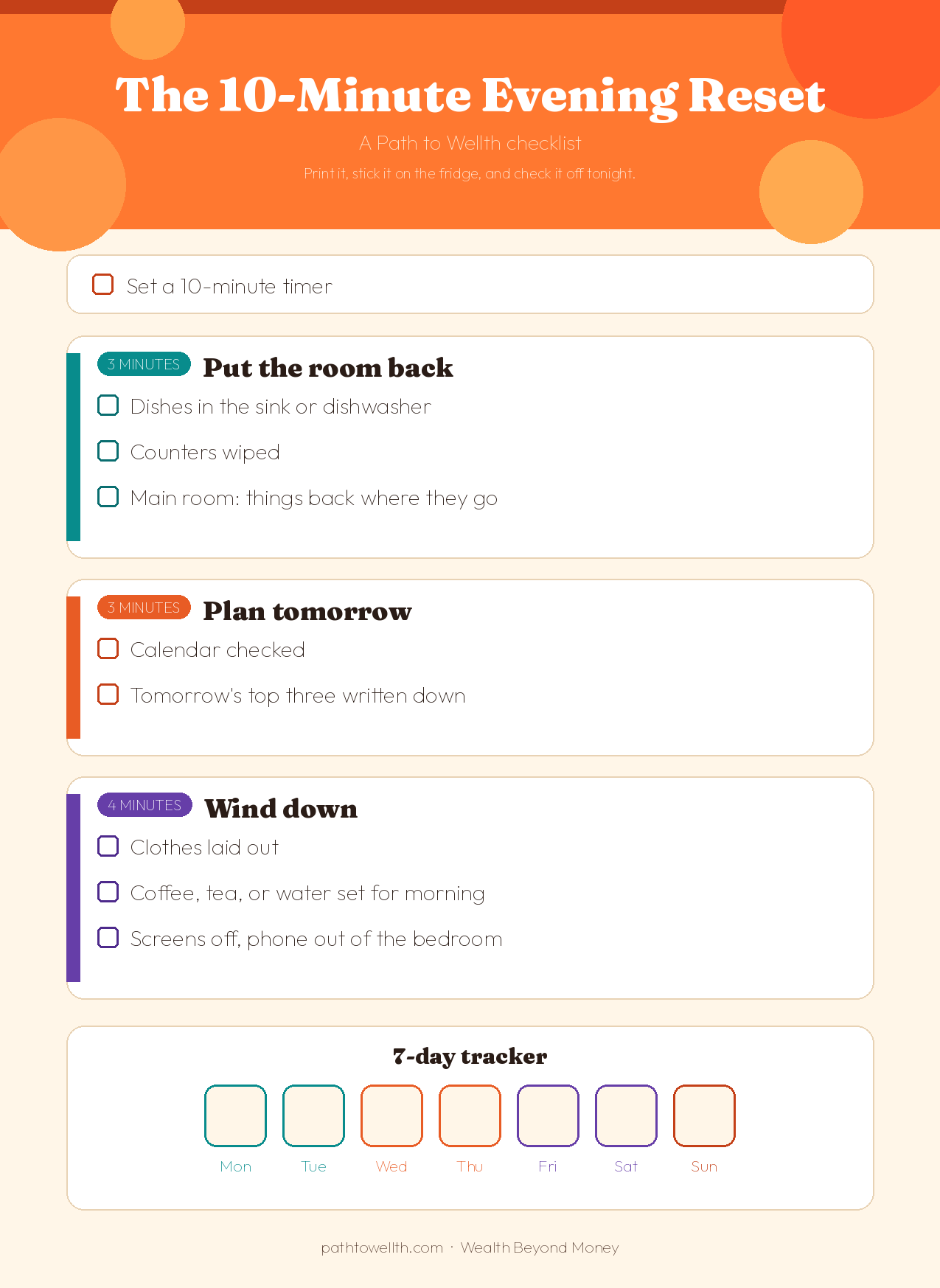
1. Three minutes: put the room back
Not a deep clean. Not the junk drawer, not the closet, not “while I’m at it.” The kitchen and the main room you actually live in.
Dishes in the sink or the dishwasher. Counters wiped. Couch cushions flipped back. The remote, the mail, the sweater on the chair: back where they go. If it won’t fit in three minutes, it isn’t tonight’s job. Write it down for later, or leave it.
This is the minimalist move, and it isn’t about a perfect house. It’s about keeping home light every day, instead of donating your entire Sunday to a mess that grew all week.
2. Three minutes: write tomorrow’s top three, and check the calendar
Open the calendar. Actually open it. Then write three tasks, not thirteen. If everything is a priority, nothing is.
Be specific. “Email Sam the invoice” beats “sort of deal with work.” “Buy oat milk” beats “errands.” Tomorrow-you shouldn’t have to decode the list.
If a fourth thing appears, it can wait, or it can replace something weaker. It’s a short handoff, so your brain can clock out.
3. Four minutes: wind down
Screens off, or at least out of the bedroom. If you need an alarm, use a cheap bedside clock, or leave your phone on a dresser in another room, not under your pillow.
Lay out tomorrow’s clothes. (Yes, even if getting dressed is already simple. Future-you, half-awake, is not a stylist.)
Set the coffee, or the tea, or the water glass, whatever your first five minutes need. The morning practically starts itself. Then stop.
What This Has to Do With Wellth
This is not a productivity hack for squeezing more into the day. I’m asking you to close the day on purpose, so tomorrow starts a little lighter. That’s a wellth habit, and it touches all three pillars.

Health. A short wind-down, with screens off, gives your body a chance to land. Better sleep is better energy, and better energy is the whole point of wellth. This pairs nicely with the “digital sunset” idea from our Sun Seeker post.
Habits. Small daily resets compound, the same way the other habits on this blog do. One tidy kitchen doesn’t change your life. A kitchen that never quite gets out of hand does. The ROI starts the first morning you don’t have to face last night’s sink before you’ve had coffee.
Smart Money Moves. Late-night scrolling is a very efficient way to buy things you didn’t plan to. Closing the laptop, and putting the phone to bed before you do, is a cousin of the 24-hour rule from our stress spending post. You’re not white-knuckling a sale at 11 p.m. You’re already off the screen.
And it sits beautifully next to the Single-Tab Hour. That habit protects your focus by day. This one protects your calm by night. One tab when you’re working; ten minutes when you’re done. Together, they keep the day from leaking into the evening, and the evening from ambushing the morning.
The 5-minute morning ritual is easier when the night before has already done some of the work. You can set up a calm morning at 10 p.m., in your socks, with a sponge.
Your 7-Day Evening Reset Challenge
Ready, Wellthers? Keep it small, and let it get easier.
Day 1: Just the three-minute tidy. Kitchen and main room. Stop when the timer rings.
Day 2: Tidy, then write tomorrow’s top three and check the calendar.
Day 3: All three steps, even if the wind-down is messy. Screens out of the bedroom counts.
Day 4: Same ten minutes, a little earlier if you can. Notice whether sleep feels different.
Day 5: All three steps. If you shop online in the evenings, make this the night you don’t.
Day 6: If you slipped yesterday, no drama. Just start the timer.
Day 7: Full reset, then jot down what felt lighter in the morning. Keep the version that helped.
That’s it. Seven nights, ten minutes, and a sink that doesn’t greet you first.
Your Evening Reset Checklist
Print it, stick it on the fridge, or save the image.
Ten Minutes Is Enough
You don’t need a Sunday reset, a new organizing system, or a personality that loves chores. You need ten ordinary minutes, most nights, and the rest of the house can still be imperfect.
Some evenings the reset will feel easy. Some evenings you’ll only manage the dishes, and you’ll go to bed anyway. Both count. It’s not about perfection, it’s about progress. Your future self, the one who wakes up to a clear counter and a plan that already exists, will thank you.
So set a ten-minute timer tonight, put the kitchen back, and ask yourself: what would tomorrow feel like if I decided it now?