
You need milk. The store is a 12-minute walk away, but you grab the car keys anyway. Four minutes of driving, three minutes circling for a parking spot, a walk across the lot, and the whole thing back again. You saved maybe five minutes, and you spent them sitting down.
We’ve all done it. For most of us the car is a genuine necessity: for the weekly shop, the school run in the rain, the commute across town. This isn’t about getting rid of it. It’s about noticing the short trips where the car is just a habit, and handing those back to your feet. Those few minutes are some of the best health deals you’ll ever find.
The 1-Mile Rule
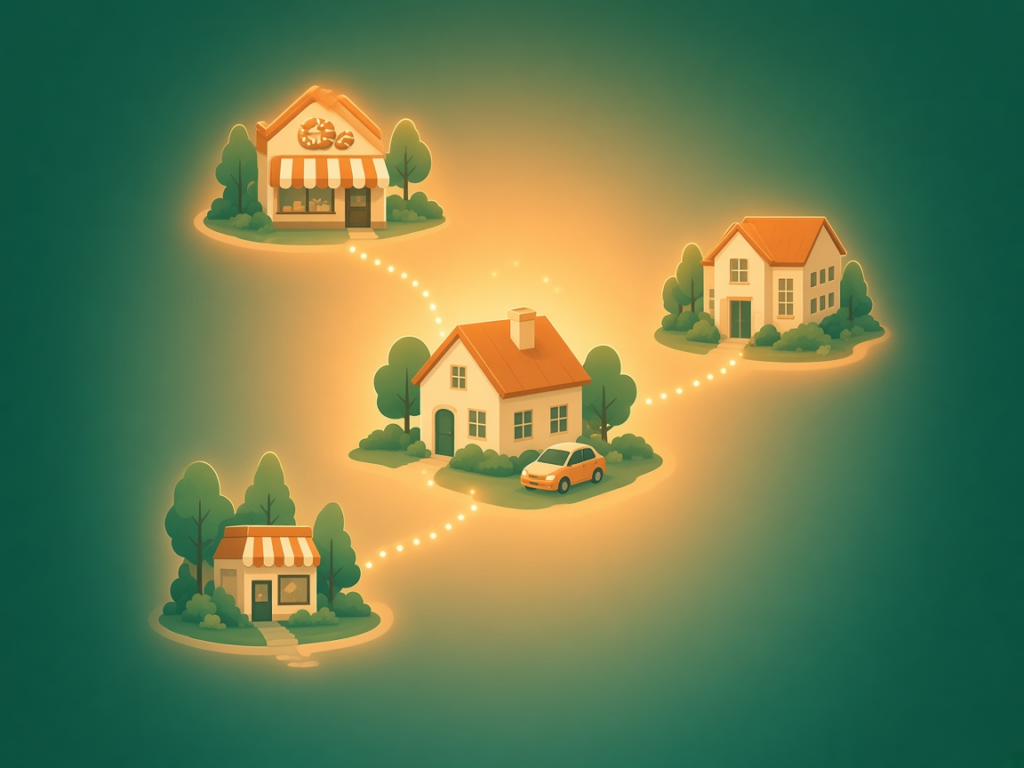
Here’s the simple rule: if a trip is under a mile (about 1.5 km) and it’s safe and practical, walk it. At an easy pace, that’s around 15 to 20 minutes. Often it’s barely slower than driving once you count parking.
Short trips are everywhere. According to the US Department of Energy, nearly 60% of all vehicle trips in 2017 were under six miles. Plenty of them were much shorter: the pharmacy, the bakery, the friend two streets over.
Start by mapping your own one-mile circle. Open a map, drop a pin on your home, and look at what’s inside it.
Walking Is Medicine
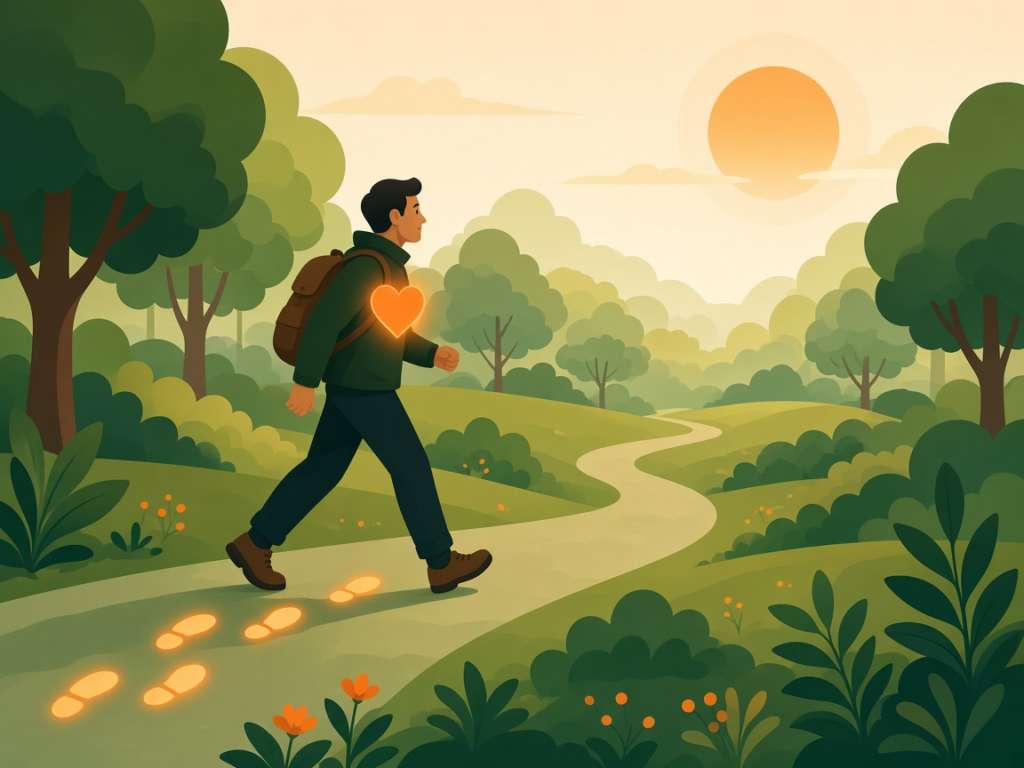
If walking came in a bottle, we’d all be buying it. The American Heart Association says at least 150 minutes a week of brisk walking can lower your risk of heart disease, stroke, and type 2 diabetes, and help with blood pressure, blood sugar, cholesterol, mood, and sleep.
The research behind it is solid:
- More steps, longer life: a 2022 analysis in The Lancet Public Health pooled 15 studies of nearly 50,000 adults. The more people walked, the lower their risk of dying during follow-up, with the benefit leveling off around 6,000 to 8,000 steps a day for adults over 60 and 8,000 to 10,000 for younger adults.
- A better mood: a 2022 review in JAMA Psychiatry found that the equivalent of 2.5 hours of brisk walking a week was linked to a 25% lower risk of depression. Even half that amount was linked to an 18% lower risk.
- Steadier blood sugar: a 2022 review in Sports Medicine found that even 2 to 5 minutes of light walking after eating lowered blood sugar and insulin more than sitting, and more than standing.
That’s why a walk to the corner shop after dinner isn’t just an errand. It’s a built-in post-meal walk.
Every Step Counts as Fitness
You don’t need a gym membership to get fit. The AHA notes that brisk walking can help your health as much as running, and that short sessions add up: three 10-minute walks count just like one 30-minute walk. As we wrote in Fitness Anywhere, the best workout is the one that fits into your actual day. A walk to the shop counts. So does the walk home.
Walk to Think

Stuck on a problem? Take it for a walk. In a 2014 Stanford study, people came up with an average of 60% more creative ideas while walking than while sitting, and the boost lasted for a little while after they sat back down.
The effect was strongest for brainstorming and open-ended ideas, not focused tasks with one right answer. And it worked indoors on a treadmill as well as outdoors, so it’s the walking itself that matters. Some ways to use it:
- Walking meetings: suggest a one-on-one on foot instead of in a meeting room
- Phone calls on the move: take calls that don’t need a screen while walking around the block
- The thinking walk: before a big decision, walk to get your coffee instead of driving to the drive-through
The Backpack Errand Stack
The secret weapon of car-light living is a good backpack. It keeps your hands free, spreads the weight evenly, and turns one walk into three errands: library, pharmacy, bakery, done.
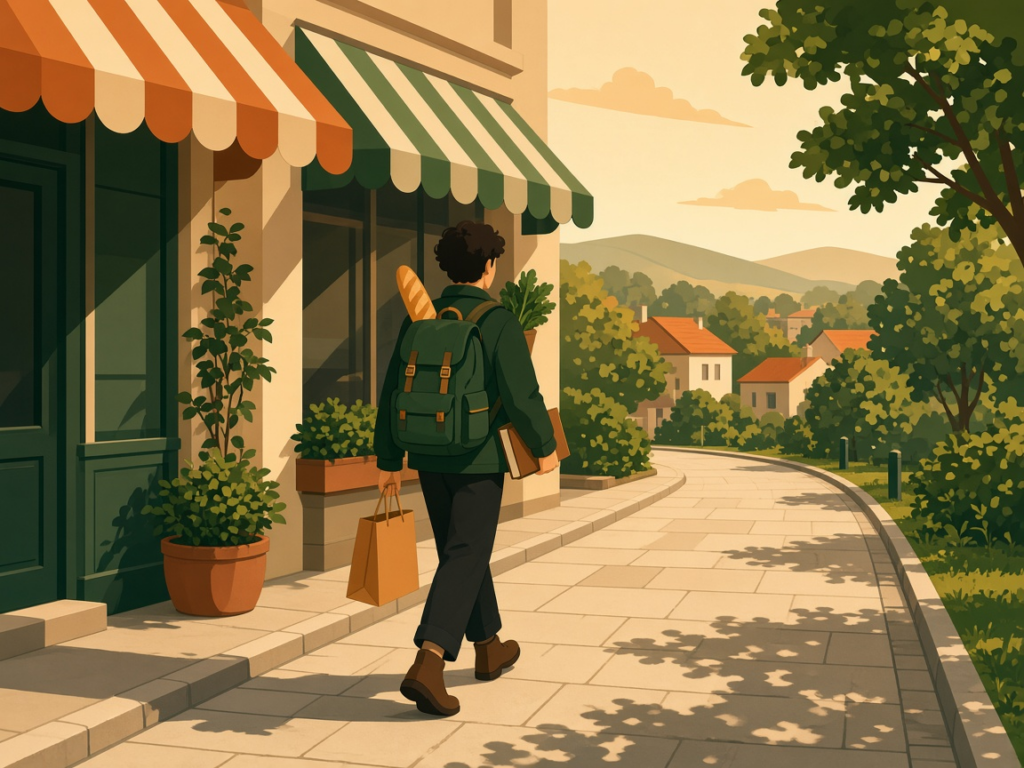
- Stack your stops: plan a loop instead of separate trips, the way you’d plan a drive
- Keep it ready: leave a foldable tote and a water bottle in your backpack so you’re never “not set up” to walk
- Buy for the walk: top-up shops on foot, big stock-ups by car. That’s the balance that works for most families
- Time it right: a walk to pick up dinner is a great way to end the workday
And there’s a small bonus for your wallet. FuelEconomy.gov points out that cars use more fuel when the engine is cold, so several short trips from a cold start can use twice as much fuel as one longer trip. Fewer short drives means a little less fuel and a little less wear on the car. Nice, but it’s the side dividend.
Your Neighborhood Is Waiting
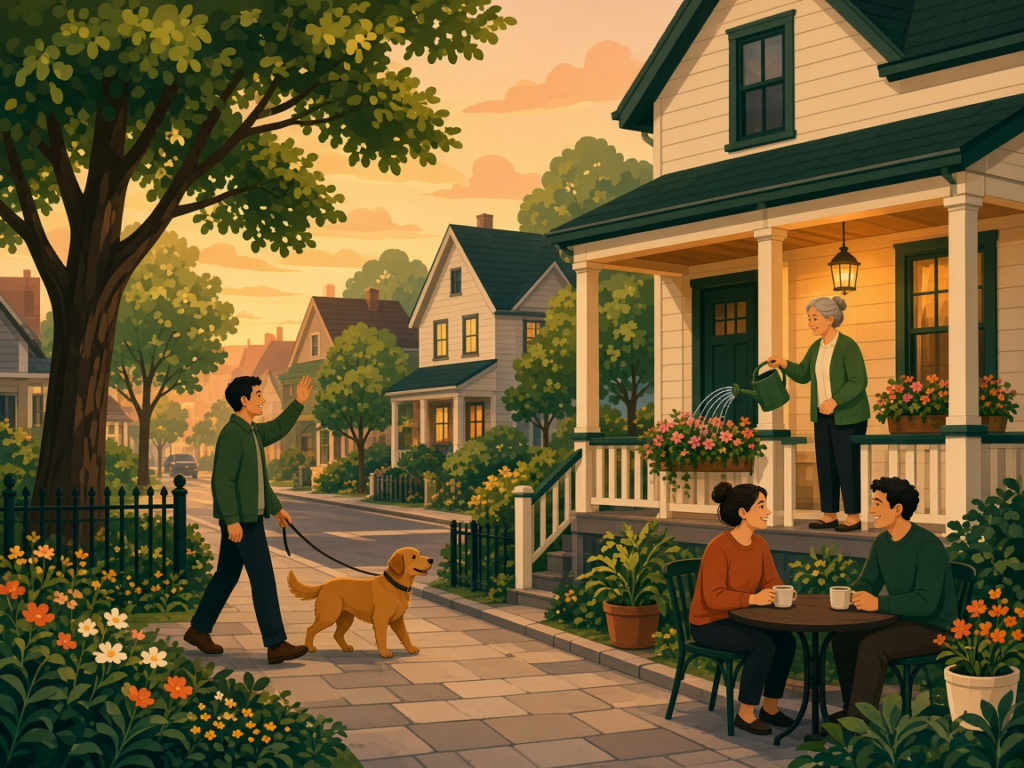
From behind a windshield, your neighborhood is just scenery. On foot, it becomes a place. You notice the new bakery, the garden that bloomed overnight, the neighbor whose name you finally learn.
In Preoccupied! we talked about how easily our screens pull us away from the world right in front of us. Walking is one of the simplest ways back. And as we explored in our hobbit post, there’s real joy in a slower, more local life: knowing your shopkeepers, waving to the people next door, and feeling at home where you live.
Every walk is a small investment in the place you live, and in the people who share it with you.
When Walking Doesn’t Make Sense
Let’s be honest: walking isn’t always the right answer. The goal is to use the car less, not to never use it. Here’s when the car (or something else) makes more sense:
- Distance and time: if a trip is long or you’re on a tight schedule, drive it and walk somewhere else
- Heavy loads: the big grocery run, furniture, or anything you can’t comfortably carry
- Safety: no sidewalks, fast traffic, or poorly lit streets at night. If you do walk in low light, the AHA suggests staying alert and wearing something reflective
- Weather: extreme heat, ice, or storms. Good shoes and a rain jacket handle most days, but not all
- Health and mobility: if walking is painful or hard, shorter distances, cycling, or water exercise may suit you better
You also don’t have to choose between all or nothing. Walk to the bus or train stop. Park at the far side of the lot, or at the edge of town and walk the last stretch. Use a bike for trips that are too far to walk but too short to be worth the car.
Your 30-Day Walk It Off Challenge
Here’s the challenge: for the next 30 days, swap one car trip a day for your feet. If you don’t have a trip that day, take a 10-minute walk after a meal instead. Keep it simple:
Week 1: Map your one-mile circle and pick your easiest swaps, like the corner shop, the café, or the school drop-off.
Week 2: Add one walking call or walking meeting, and try a 10-minute walk after dinner.
Week 3: Stack your errands. Do one backpack loop that replaces a full car outing.
Week 4: Combine. Walk to the bus, bike a slightly longer trip, or park farther away.
Each day, track three things in a notebook or your phone: your steps, the trips you walked, and how you felt (energy, mood, sleep). After 30 days, look back. Most people notice the change in how they feel well before they see it on any scale.
Small Steps, Big Returns
You don’t need to give up your car. You just need to notice the short trips, and take a few of them back. A walk to the shop is a dose of medicine, a creative boost, and a hello to your neighbors, all in about fifteen minutes.
It’s not about perfection – it’s about progress. One trip at a time, one step at a time.
So the next time you reach for the car keys for a trip around the corner, ask yourself: could I just walk it off?
Note: This article is for general information only and isn’t medical advice. If you have a health condition or mobility concerns, check with your doctor before starting a new activity routine.