
The alarm goes off. You reach for your phone, scroll under the duvet, and shuffle to the kitchen without opening a curtain. By 11 you’re foggy. By midnight you’re somehow wide awake.
Sound familiar? Here’s the thing: you don’t have a willpower problem. You have a light problem. Most of us start the day in a dim room, staring at a bright little screen, and our body clock never gets a clear “morning” signal.
Today’s habit fixes that, and it costs nothing, needs no gadget, and asks you to give nothing up. Just a few minutes of real daylight in the first hour after you wake. I call it the Sunlight Minute.
You Woke Up Indoors
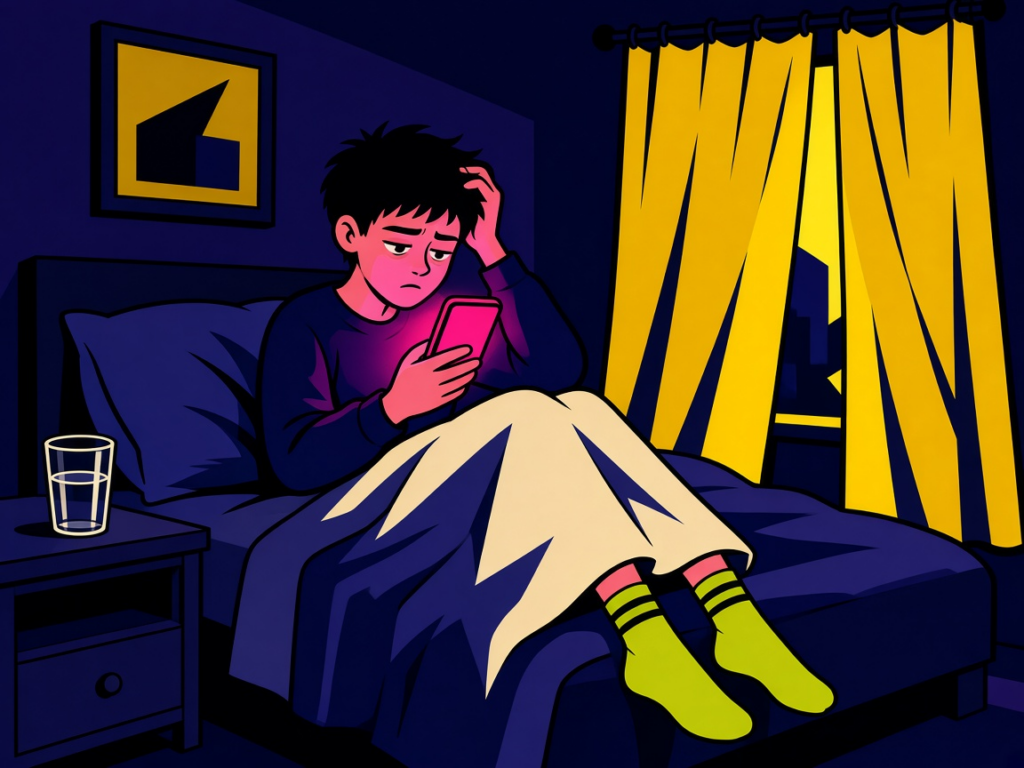
Most mornings now happen under a roof, in light that’s surprisingly weak compared with even a grey sky outside. The phone is bright, but it’s not the same as daylight, and it usually finds your face before the sun does.
We’ve written before about screens, late-night light, and your body clock in From Screen Slave to Sun Seeker. This post isn’t a remake of that one. It’s one tiny morning move: get your eyes a dose of daylight early, and let the rest of the day go better.
The fog at 11 and the “wired at midnight” feeling often travel together. When morning is dim and evening is bright, the clock can drift later. You feel sluggish when you want to be on, and alert when you want to be out.
Why a Few Minutes of Morning Light Help
Your body clock uses light, especially light in the eyes in the first part of the day, as one of its main time cues. Morning daylight tends to support daytime alertness, and it helps schedule that sleepy feeling for later, at a more regular hour. That’s the shift, in plain language: a clearer “it’s morning” signal.

This isn’t a cure for insomnia, and it isn’t a substitute for medical advice. If sleep problems are ongoing, or you have a condition that affects your eyes or skin, talk to a doctor. And never look directly at the sun. Looking toward the sky, the horizon, or a bright scene is enough. Your eyes are doing the work just by being outdoors.
A team of sleep and lighting researchers, in a 2022 consensus paper, recommended making daytime light a lot brighter at eye level, and said daylight should be the first tool you reach for. In an earlier study, Kenneth Wright and colleagues found that when people spent a week in natural light only (they went camping), their internal clocks shifted earlier and lined up more closely with the actual day. You don’t need to go camping. You do need more of that outdoor cue, early, in a form you’ll actually repeat.
How Much Light Is Enough?
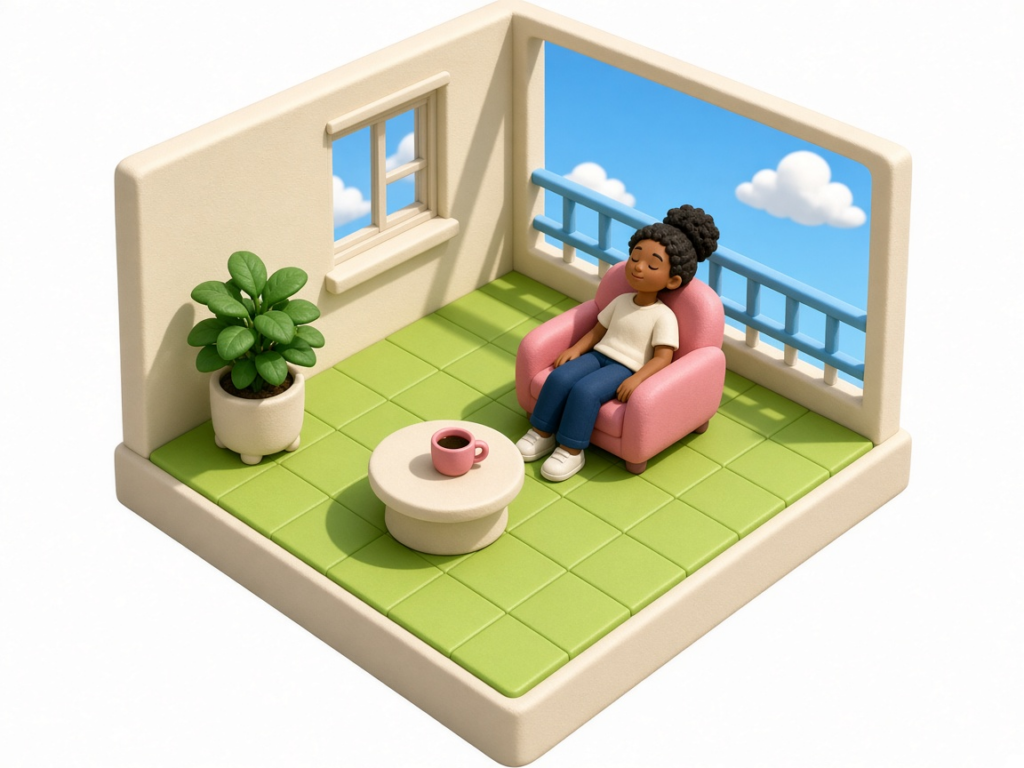
The name is “the Sunlight Minute” because the bar should be almost ridiculously low. On a bright morning, even a few minutes outdoors can deliver far more useful light than a long stretch in a typical room. A practical target:
- A bright, clear morning: a few minutes is a solid start; five to ten is plenty for most of us.
- A cloudy day: stay out longer, ten to twenty minutes if you can. Overcast outdoor light is still much brighter than your kitchen.
- A dark winter morning: go out once the sky is actually up, even if that’s later than your alarm. Longer is better when the light is thin.
You don’t need a tracker, a lux meter, or a special lamp to begin. If you want the fuller picture — evening lighting, screens at night, and options for very dark winters — that’s in the Sun Seeker post. Today’s job is just the first minutes of the day.
Cloudy Days, Winter, and the Open Window
Here’s the thing most people get wrong: grey weather is not a free pass to skip it. A cloudy sky is still daylight. It’s just a little less intense, so you give it more time.

Winter is harder, especially if you wake before sunrise. Do the minute when the light arrives, not in the dark with a polite idea of “morning.” A balcony, a doorstep, a walk to the corner — all count.
If you truly can’t get out (a high floor, a sick day, a downpour), stand by an open window or on a balcony and look at the sky, not at the glass in front of a dim courtyard. Windows cut the intensity, so this is a backup, not the first choice. The moment you can step outside, do that instead.
(Yes, you can wear glasses. You can wear a coat. You can look a bit silly holding a mug on the doorstep. The habit still works.)
Stack It Onto Something You Already Do

A habit this small only sticks if it rides on something you already do.
- Coffee or tea on the balcony (or the doorstep): Take the mug outside. That’s the whole ritual.
- Water first, then light: If you’ve already started Water First, drink the glass, then step out. Two free habits, one trip to the kitchen.
- A short walk that’s already on the map: The bakery, the kiosk, the next street over. If it’s a short trip you’d usually do by car, and it’s safe and practical, walk it. This isn’t about giving up the car. It’s about using it less when the errand is around the corner, and collecting daylight on the way. We went deeper on that in Walk It Off.
- After your five quiet minutes: If you do the 5-minute morning ritual, the Sunlight Minute is a natural next step: sit, breathe, then go to the light.
Pair it with your Evening Reset at the other end of the day, and you’ve gently bookended the clock: light early, wind-down later. No new system. Just two small hinges.
What This Has to Do With Wellth
A minute of daylight looks almost too small to matter. That’s the point.

Health. Steadier alertness by day, and a better chance of feeling sleepy at a sensible hour, without buying a thing. Energy you can actually use is the beginning of wellth.
Habits. The compound effect loves tiny, repeatable cues. One minute you won’t skip beats a 30-minute “morning routine” you abandon in February.
Smart Money Moves. This one is free. No gadget, no subscription, no app. The money you don’t spend on another energy fix is a quiet little win, and the real return is a clearer morning.
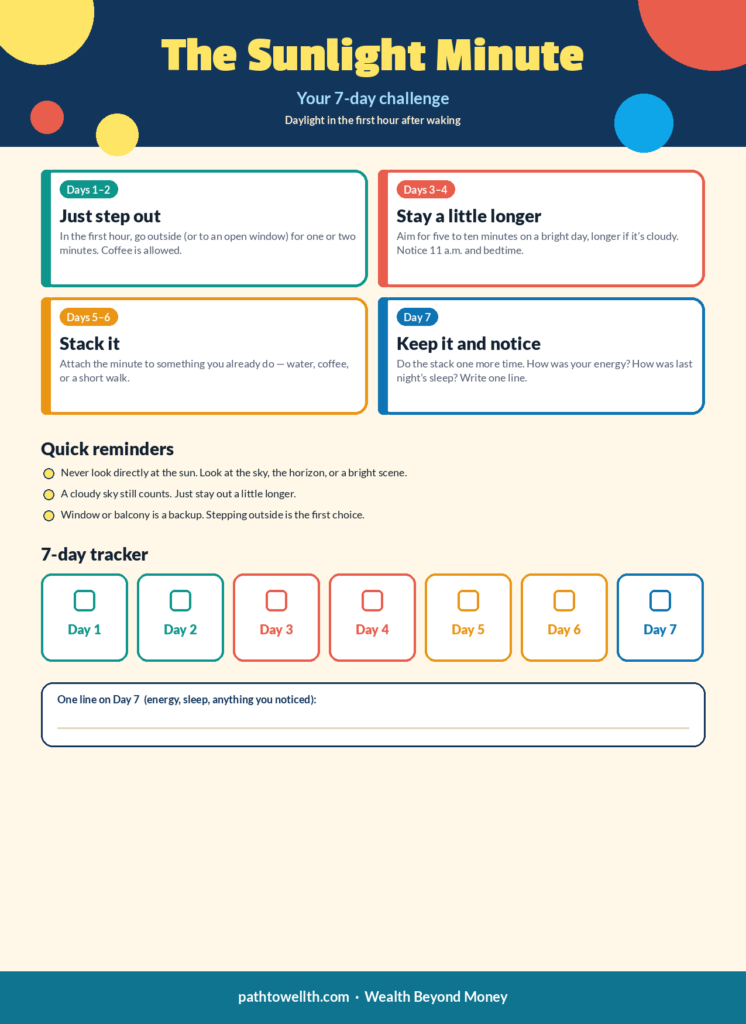
Your 7-Day Sunlight Minute Challenge
Ready, Wellthers? One week. No gear. No perfect sunrise.
Days 1-2, Just step out: In the first hour after waking, go outside (or to an open window or balcony) for one or two minutes. Coffee is allowed. That’s it.
Days 3-4, Stay a little longer: Aim for five to ten minutes on a bright day, longer if it’s cloudy. Notice 11 a.m., and notice bedtime.
Days 5-6, Stack it: Attach the minute to something you already do — water, coffee, or a short walk.
Day 7, Keep it and notice: Do the stack one more time. How was your energy? How was last night’s sleep? Write one line, not a report.
Your Sunlight Minute Checklist
Save it, print it, or stick it on the fridge next to the coffee.
A Minute That Sets the Day
You don’t need a light-therapy lamp, a 5 a.m. personality, or a cabin in the woods. You need a door, a bit of sky, and a minute you’ll actually take.
Some mornings you’ll forget and do it at 10. Some mornings it will rain and you’ll stand in the doorway. Both count. It’s not about perfection, it’s about giving your body a clear “good morning” so the rest of the day — and the night — can follow. Your future self will thank you.
So tomorrow, before the scroll gets comfortable, open the door, look at the sky, and ask yourself: what would 11 a.m., and midnight, feel like if morning actually started with light?